


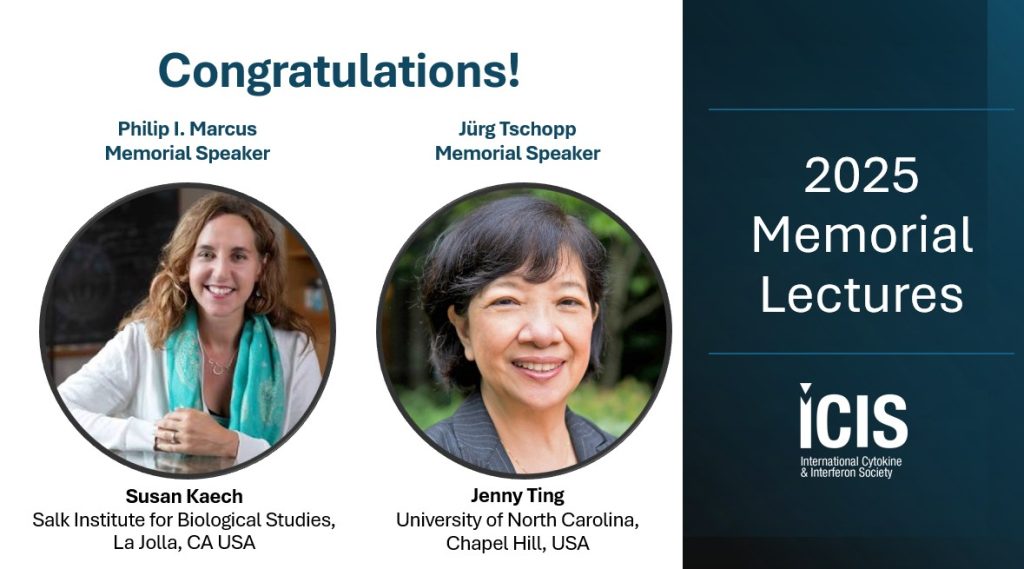
We are delighted to announce two exceptional researchers who will deliver the prestigious memorial lectures at Cytokines 2025 – the 13th Annual Meeting of the International Cytokine & Interferon Society. Dr. Susan Kaech from the Salk Institute for Biological Studies will present the Philip I. Marcus Memorial Lecture, while Dr. Jenny Ting from the University of North Carolina at Chapel Hill will deliver the Jürg Tschopp Memorial Lecture. These selections honor two giants in our field while celebrating the groundbreaking work of today’s leading immunologists.
Susan Kaech: Pioneer in T Cell Memory and Cancer Immunometabolism
Dr. Susan Kaech, Director of the NOMIS Center for Immunobiology and Microbial Pathogenesis and holder of the NOMIS Chair at the Salk Institute, brings decades of transformative research to the Philip I. Marcus Memorial Lecture. Her work has fundamentally shaped our understanding of how immune memory forms and why it sometimes fails in chronic disease and cancer.
Recent Breakthrough Discoveries
Kaech’s laboratory continues to break new ground in immunology. In a recent Science publication, her team demonstrated how nutrient metabolism directly controls T cell fate decisions. They discovered that exhausted T cells shift from acetate to citrate metabolism, revealing a “nutrient-driven histone code” that determines whether T cells remain functional or become exhausted during chronic infections and cancer. This work opens entirely new therapeutic avenues for enhancing T cell responses.
Her 2024 Cancer Research publication unveiled how the scavenger receptor CD36 in tumor-associated macrophages suppresses type I interferon signaling, providing a novel mechanism by which tumors evade immune surveillance. Working with longtime collaborator Gerald Shadel, Kaech’s team also discovered that rewiring electron flow in tumor mitochondria can enhance the immune system’s ability to recognize and fight cancer.
Leadership and Recognition
Kaech’s contributions extend far beyond the laboratory. In 2024 she received the ICIS Mentorship Award and was elected to the National Academy of Sciences. She also serves on the American Association of Immunologists Council and as an academic editor for the Journal of Experimental Medicine. Her recent election to the American Academy of Arts and Sciences (2023) and recognition as an AAAS Fellow (2020) underscore her influence across multiple scientific disciplines.
The Salk Institute recently received a $20 million NOMIS Foundation grant to launch a Neuroimmunology Initiative under Kaech’s leadership, reflecting her expanding influence into the intersection of neuroscience and immunology. Her lab’s latest work reveals that T cells respond to neurotransmitters released by neighboring neurons, opening an entirely new field of neuroimmunology.
Jenny Ting: Architect of Inflammasome Biology
Dr. Jenny Ting, William Kenan Distinguished Professor of Genetics and Professor of Microbiology and Immunology at UNC Chapel Hill, brings unparalleled expertise in innate immunity to the Jürg Tschopp Memorial Lecture. As President of the American Association of Immunologists from 2020-2021, Ting has been a driving force in advancing immunological research and its clinical applications.
Defining the NLR Field
Ting’s laboratory discovered the NLR protein family, fundamentally changing how we understand innate immune recognition. Her work established that many NLRs function as negative regulators of inflammation, maintaining immune balance. For example, her discovery that NLRX1 reduces cancer-promoting inflammation has led to strategies for repurposing conventional anti-inflammatory therapeutics to combat cancer and colitis.
Current Research Frontiers
Ting’s recent work spans from COVID-19 pathogenesis to multiple sclerosis therapy. Her 2024 studies in Science Immunology revealed how SARS-CoV-2 induces specific forms of cell death in human airway epithelium, providing crucial insights into COVID-19 pathology. She was recently awarded a new grant from the National Multiple Sclerosis Society to investigate novel beneficial gut microbes for potential MS therapy.
Her laboratory’s continued focus on host-microbiome interactions has revealed how NLRs maintain tolerance to beneficial bacteria while preventing microbial imbalance. This work suggests therapeutic pathways for restoring colon health by targeting specific bacterial communities.
Innovation in Vaccine Development
Beyond basic research, Ting’s team develops cutting-edge vaccine technologies using nanoparticles and microparticles to deliver innate immune agonists. They focus on difficult-to-treat cancers including triple-negative breast cancer and high-impact infections such as influenza, Dengue, and Zika viruses.
Recognized as a Highly Cited Researcher for five consecutive years (2020-2024) and elected to the American Academy of Arts and Sciences in 2022, Ting received the ICIS-Pfizer Award for Excellence in Interferon and Cytokine Research in 2021, cementing her status as a leader in cytokine biology.
Honoring Scientific Legends
Philip I. Marcus (1927-2013): The Interferon Pioneer
The Philip I. Marcus Memorial Lecture honors a true giant of interferon research. Dr. Marcus spent over 60 years investigating viruses and interferon, earning the nickname “Mr. Interferon” for his pioneering contributions since 1966. As Editor-in-Chief of the Journal of Interferon and Cytokine Research for 18 years, he shaped the field’s scientific discourse.
Marcus made seminal discoveries including the identification of the world’s most efficient inducer of interferon—a single molecule of double-stranded RNA—and the molecular cloning of the first non-human (avian) interferon. His 1955 work as a graduate student described the first technique for cloning mammalian cells, specifically HeLa cells, a breakthrough that remains fundamental to modern cell biology.
Beyond research, Marcus was deeply committed to mentoring the next generation of scientists. Named an Honorary Member of the International Society for Interferon and Cytokine Research in 2005, he received their Distinguished Service Award in 2011. His annual virology course at the University of Connecticut, taught for 36 years, was both sought after and feared—a testament to his commitment to scientific rigor and excellence.
Jürg Tschopp (1951-2011): Revolutionary of Inflammation Research
The Jürg Tschopp Memorial Lecture commemorates the Swiss biochemist who revolutionized our understanding of inflammation and cell death. Tschopp’s greatest achievement was his team’s discovery and naming of the inflammasome in 2002—a breakthrough that sparked a renaissance in innate immunity and inflammatory disease research.
Tschopp demonstrated that spontaneous hyperactivation of the inflammasome underlies hereditary periodic fever syndromes, leading directly to successful clinical therapies using IL-1 receptor antagonists. His brilliant insight that uric acid crystals activate the NLRP3 inflammasome provided the molecular basis for gout pathogenesis and opened new therapeutic avenues.
His work extended far beyond basic research. Tschopp identified inflammasome agonists ranging from microbial molecules to sterile inflammation triggers like asbestos and silica. He introduced the critical concept of the “metabolic inflammasome,” linking metabolic stress to obesity and type 2 diabetes—work that continues to influence therapeutic development today.
Winner of the Louis-Jeantet Prize for Medicine in 2008 and the Novartis Prize for Clinical Immunology in 2010, Tschopp authored over 350 publications with an h-index of 105. His tragic death in 2011 during a hiking accident in the Swiss Alps robbed the scientific community of a brilliant mind, but his discoveries continue to transform medicine.
Looking Forward
The selection of Susan Kaech and Jenny Ting for these memorial lectures represents the perfect intersection of honoring our field’s past while celebrating its dynamic future. Both speakers embody the spirit of scientific innovation and clinical translation that Marcus and Tschopp championed.
As we gather for Cytokines 2025, these lectures will undoubtedly inspire new collaborations, spark innovative research directions, and remind us of the profound impact that dedicated scientists can have on human health. The legacy of discovery continues, carried forward by exceptional researchers like Kaech and Ting who push the boundaries of what we know about immunity, inflammation, and the intricate dance between health and disease.
Bottom Line: The 2025 memorial lectures feature two world-class scientists whose groundbreaking research in T cell memory, cancer immunometabolism, inflammasome biology, and host-microbe interactions continues the transformative legacy of Philip Marcus and Jürg Tschopp in advancing both fundamental immunology and clinical therapeutics.

